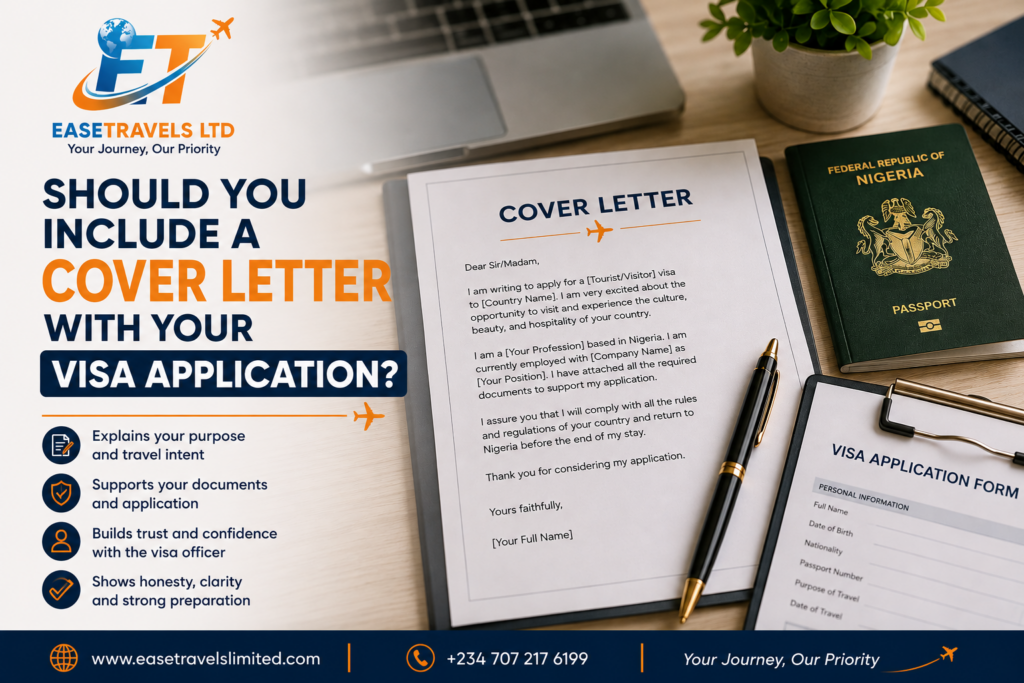
Wondering if a cover letter actually helps your visa application? Here’s when it’s required, when it’s optional, and how to write one that strengthens your case.
Should You Include a Cover Letter With Your Visa Application?
Two colleagues applied for the same Schengen visa around the same time, for nearly identical trips, same destination, similar bank statements, comparable employment history. One included a well-written cover letter explaining her trip clearly. The other submitted only the standard required documents, assuming the forms already said everything necessary. She got approved within two weeks. He waited nearly six weeks and received a request for additional clarification before eventually being approved with unnecessary delay and stress.
Nothing about their financial situations was meaningfully different. The difference was that her application told a clear, connected story, and his left the visa officer to piece things together from scattered documents.
This is exactly why the question of whether to include a cover letter matters more than people assume. It’s not always mandatory, but when done well, it can be the detail that moves your application from “acceptable” to “clearly convincing.”
This guide breaks down when a cover letter is required, when it’s simply smart to include one anyway, and how to write one that actually strengthens your case rather than just repeating what’s already in your documents.
What a Visa Cover Letter Actually Is
A visa cover letter is a concise, written explanation accompanying your visa application that ties your documents together into a coherent narrative. It’s not the same as a job application cover letter, it’s not about persuading someone you’re impressive. It’s about giving the visa officer a clear, quick understanding of who you are, why you’re traveling, and why they should feel confident you’ll return home.
Think of it as the summary that connects the dots between your bank statement, your employment letter, your itinerary, and your travel history, rather than leaving the officer to interpret how those pieces fit together on their own.
When a Cover Letter Is Required vs. Optional
Countries/Visa Types That Explicitly Require One
- Some Schengen country embassies (Germany and France, in particular) list a cover letter as a required document for certain visa categories, especially business visits and long-stay visas
- UK visa applications, while not always explicitly mandatory, strongly benefit from a personal statement or cover letter for complex cases, such as previous refusals or unconventional financial situations
Countries Where It’s Optional But Recommended
- Canada visitor visa applications don’t strictly require a cover letter, but immigration consultants consistently note that a clear, well-written one improves an application’s overall clarity
- Standard Schengen tourist applications for straightforward trips often don’t require one, but including a brief one rarely hurts and can help in borderline cases
Countries Where It’s Rarely Necessary
- Dubai/UAE visa applications, processed largely through airlines and agencies, typically don’t involve or expect a cover letter, since the process is more standardized and less officer-discretionary
- Visa-on-arrival or eVisa systems (Rwanda, Kenya, Egypt) generally don’t have a mechanism for including one at all
What to Include in a Strong Cover Letter
Purpose of Travel
State clearly and specifically why you’re traveling, not just “tourism,” but the actual reason: a family wedding, a business conference, a leisure trip to specific cities with a clear plan.
Trip Itinerary Summary
Briefly summarize your travel dates, destinations, and key activities, reinforcing what’s already in your detailed itinerary document rather than contradicting or vaguely restating it.
Ties to Home Country
This is often the most important section. Clearly state your employment situation, business ownership, family responsibilities, or property in Nigeria, anything that reinforces your intention and ability to return.
Financial Capability Summary
Briefly reference how you’re funding the trip, without simply repeating your bank statement numbers. If you’re self-funded, say so clearly. If sponsored, name your sponsor and their relationship to you.
Who’s Paying and How
Be explicit about whether you’re self-funding, being sponsored by family, or traveling on a company-funded business trip. Ambiguity here creates unnecessary follow-up questions.
Tone and Length Guidance
Keep it professional, direct, and no longer than one page. Visa officers review hundreds of applications; a cover letter that respects their time with clarity and brevity works far better than one trying to over-explain or emotionally persuade.
Common Mistakes That Weaken a Cover Letter
Being Too Vague or Generic
A cover letter filled with template language, “I am excited to visit your beautiful country”, adds nothing. Specificity is what makes a cover letter useful, not pleasantries.
Repeating Documents Instead of Tying Them Together
The purpose of a cover letter isn’t to restate your bank statement or itinerary line by line. It’s to connect them into a clear narrative the officer can follow quickly.
Overly Emotional or Irrelevant Details
Long personal stories about how much you’ve always dreamed of visiting a country, while heartfelt, don’t help a visa officer assess your application. Keep the focus on facts that support your case.
Inconsistencies With Other Application Documents
If your cover letter states a different travel date, different sponsor, or different purpose than your other documents, this creates doubt rather than clarity. Always cross-check your cover letter against your full application before submission.
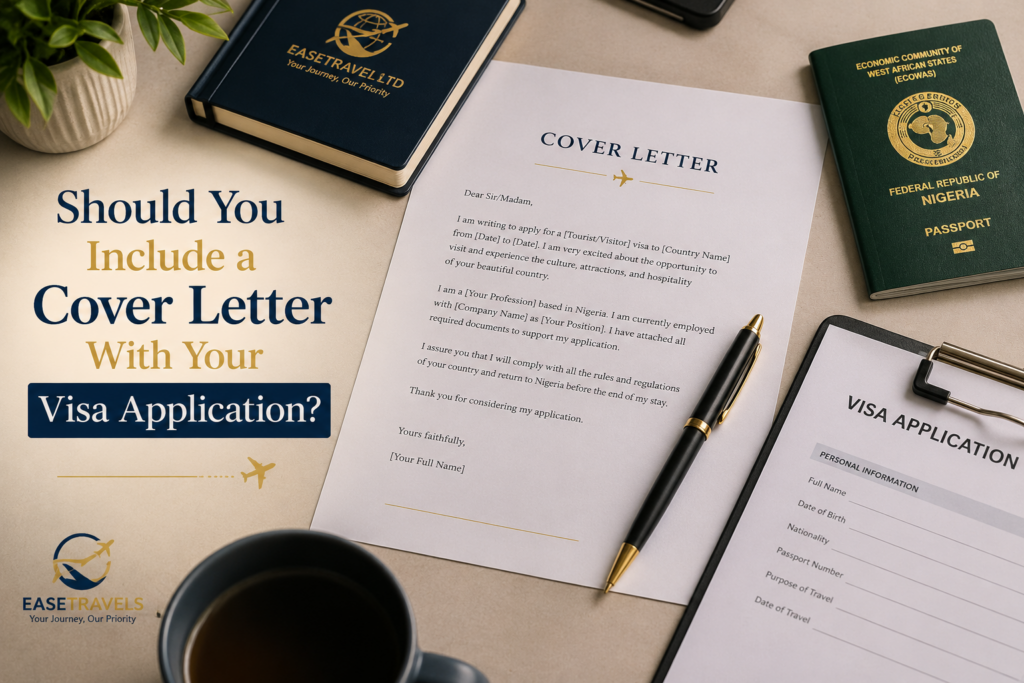
Sample Cover Letter Structure
A strong cover letter generally follows this structure:
- Opening — Your name, passport number, and the purpose of the letter (supporting your visa application)
- Paragraph 1 — Purpose of travel, stated clearly and specifically
- Paragraph 2 — Brief itinerary summary and travel dates
- Paragraph 3 — Your ties to Nigeria (employment, business, family)
- Paragraph 4 — Financial arrangement for the trip (self-funded or sponsored)
- Closing — A brief, professional statement confirming your intention to return, followed by your signature
Why This Matters More for Us
Why a Well-Written Cover Letter Matters More for Nigerian Applicants
Given the additional scrutiny Nigerian financial documents and travel intentions often face, a clear, well-organized cover letter can genuinely help bridge gaps that scattered documents alone might leave open to misinterpretation. It won’t fix a genuinely weak application, but for a solid one, it removes ambiguity that could otherwise trigger unnecessary follow-up requests or delays.
Common Mistakes Nigerian Applicants Make
The most frequent issue we see is applicants copying a cover letter template found online word-for-word, sometimes not even updating details like the destination country or the sponsor’s name. Visa officers review thousands of applications and recognize generic templates immediately. A cover letter should reflect your specific, genuine situation, not a copy-pasted format found through a Google search.
Language and Tone Considerations
Write in clear, professional English, avoiding overly formal or unnatural language that doesn’t match how you’d naturally communicate. A cover letter that reads authentically tends to land better than one stuffed with phrases clearly borrowed from a “sample visa cover letter” article.
Fake Agents Charging High Fees for “Guaranteed Approval” Cover Letters
Be cautious of agents charging significant fees specifically for “specialized” cover letters promising guaranteed approval. A cover letter is a supporting document, not a magic solution, and no legitimate service can guarantee a visa outcome based on how a letter is written.
Quick Reference: Cover Letter Requirements by Visa Type
| Visa Type | Cover Letter Required? | Recommended? |
|---|---|---|
| Schengen (Germany, France – business/long stay) | Yes | Yes |
| Schengen (standard tourist) | No | Yes, for borderline cases |
| UK Standard Visitor Visa | No | Yes, especially for complex cases |
| Canada Visitor Visa | No | Yes |
| Dubai/UAE Visa | No | Not typically applicable |
| Visa-on-arrival/eVisa (Rwanda, Kenya, Egypt) | No | Not applicable |
Conclusion
A cover letter won’t rescue a weak visa application built on inconsistent documents or insufficient financial proof, but for a solid application, it can be the detail that removes doubt and speeds up approval. The colleague who included one wasn’t more qualified or wealthier than the one who didn’t, she simply gave the visa officer a clear story to follow instead of scattered pieces to interpret.
Not sure whether your specific visa application needs a cover letter, or want help writing one that actually strengthens your case? Contact Us Today and let’s get your application ready properly.
And if you know someone currently preparing their visa application, share this with them. Sometimes the smallest addition makes the biggest difference.
Safe travels.